
With reference to the Press Release issued by the Ministry of Home Affairs (MOHA) on 14
January 2026, the Expatriate Services Division of Immigration Department of Malaysia wishes
to inform that a revised expatriate salary policy will be implemented effective 1 June 2026,
following the Cabinet’s approval on 17 October 2025.
One of the Key elements introduced under the new policy is the succession plan requirement,
which aims to ensure the structured transfer of knowledge & expertise to local employees
throughout the expatriate’s employment period.
The existing expatriate salary policy, which was based on the decision of the Economic Council
meeting dated 20 December 2016, has been further strengthened through a series of structured
engagements with industry players and relevant stakeholders since 2022. The revised policy
aligns with the objectives of the Thirteenth Malaysia Plan (RMK-13) to reduce reliance on
foreign labour and to prioritise the employment of suitably qualified local talent.
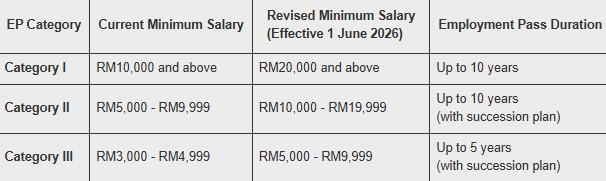
Under this policy, the minimum salary thresholds for Employment Pass (EP) Categories I, II,
and III have been revised, and a structured employment duration framework has been
introduced. These measures aim to support sustainable economic growth while strengthening
the development of local talents.
Revised Employment Pass Salary Thresholds
The 1:3 Internship Policy
Spearheaded by the Ministry of Human Resources and implemented via TalentCorp, the 1:3
Internship Policy (Dasar Latihan Amali 1:3) ensures that expatriates contribute to the local
talent pipeline:
The Requirement: Employers are encouraged/proposed to provide one structured, paid
internship for every approved EP.
The Benefit: Placements must be registered under the National Structured Internship
Programme (MySIP). This entitles companies to double tax deductions for monthly allowances
paid to students (up to RM5,000 per student per year).
Companies can submit applications and track the 3-6-0 evaluation of their interns via the
TalentCorp MyNext Platform.
Residence Pass-Talent (RP-T)
For highly qualified expatriates who wish to remain in Malaysia long-term (up to 5-10 years),
TalentCorp offers the Residence Pass-Talent (RP-T). To qualify for standard RP-T, applicants
must earn a minimum base salary of RM15,000 per month and fulfill specific tax, degree, and
tenure conditions, with further specific criteria for the “RP-T Post-10-Years” extension.
All new and renewal Employment Pass applications submitted on or after 1 June 2026 shall
comply with the revised requirements. Companies are strongly encouraged to plan in advance
and align their workforce strategies accordingly.
In preparation for the full implementation of this policy, MOHA will conduct engagement and
consultation sessions with relevant stakeholders, including industry players, employers, and
related agencies. These sessions aim to provide clarity on policy requirements and
implementation mechanisms, ensuring a smooth, transparent, and orderly transition that does
not disrupt business continuity.
In line with the principles of Malaysia MADANI, the Government remains committed to
ensuring that all policy enhancements are implemented in a gradual, balanced, and inclusive
manner, while prioritising national interests, promoting sustainable economic growth, and
fostering the long-term development of local human capital.
The Succession Plan
The succession plan is aimed at ensuring a structured and systematic transfer of knowledge and
expertise from expatriates to local employees throughout the employment tenure. This
initiative supports the Government’s objective to strengthen local talent development while
maintaining business continuity and operational efficiency.
As part of a phased implementation approach, the requirement to submit and comply with the
succession plan will only take effect from 1 January 2027 onwards. This transition period is
provided to allow organisations sufficient time to prepare, plan, and align their internal
workforce strategies with the new requirement.
In the meantime, companies are encouraged to take proactive steps to identify suitable local
successors and establish comprehensive training and knowledge transfer frameworks in
preparation for full implementation